

Destination Overview
An overview of destinations in the Ours platform, including configuration, secure data forwarding, and integrations with analytics, advertising, and big data platforms.
Destinations in Ours are the platforms where your tracked data is sent. These include analytics tools, advertising platforms, and big data services. This guide explains how destinations work, how to configure them, and best practices for managing your data flows.
What is a Destination?
A destination is any third-party platform or tool that receives event data from Ours. Destinations can be:
- Analytics Platforms: Tools like Google Analytics or Mixpanel for tracking visitor behavior.
- Advertising Platforms: Services like Facebook Ads or Google Ads for campaign performance and conversion tracking.
- Big Data Tools: Platforms like Amazon S3 or Google BigQuery for long-term storage and analysis.
By configuring destinations, you ensure that your data flows securely and efficiently to the tools you rely on.
Configuring Destinations
Adding a Destination
To add a destination:
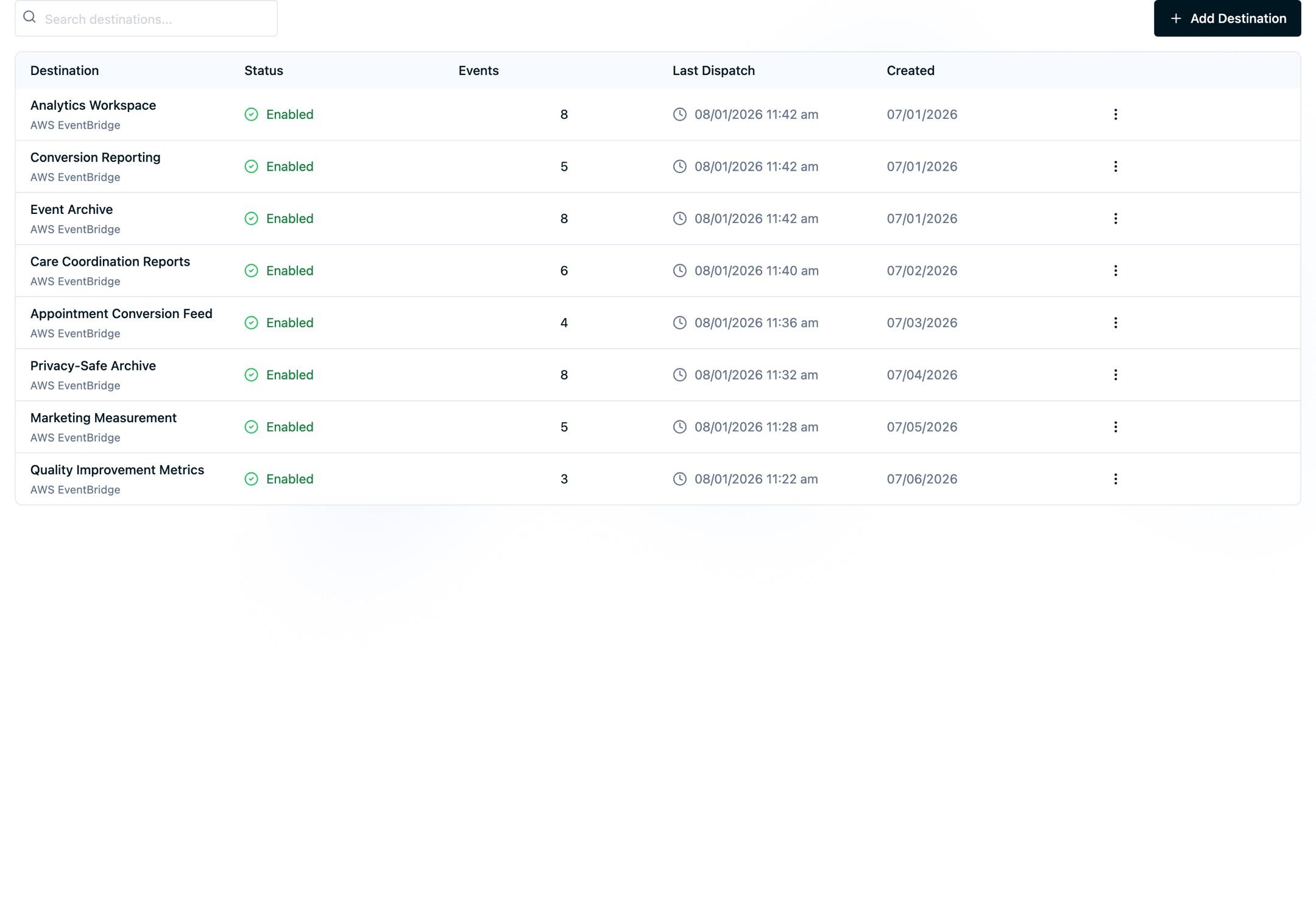
- Go to the Destinations section in your Ours dashboard.
- Select the desired destination (e.g., Google Analytics, Facebook Ads).
- Enter the required credentials or API keys.
- Customize the destination-specific settings, such as:
- Hashing or redacting sensitive data (e.g., email, phone number).
- Mapping event properties to the destination’s schema.
Destination-Specific Requirements
Each destination has unique requirements for event names and properties. For example:
- Facebook Ads: Requires specific properties like
email,phone_number, andcityfor improved match rates. - Google Ads: Uses query parameters like
gclidfor conversion tracking.
Refer to the individual destination guides.
Privacy and Compliance
Ours prioritizes security and compliance when forwarding data to destinations. You can configure privacy settings for each destination, including:
- Hashing: Apply cryptographic hashing to sensitive fields like email or phone numbers.
- Redacting: Remove fields that shouldn’t be sent to certain platforms.
- Field Selection: Specify which properties are sent to ensure compliance with HIPAA, GDPR, or CCPA.
Limited Data Use (LDU)
Most ad platforms accept a per-event flag that tells them to handle a person's data as a service provider rather than as an independent controller: no broad behavioral profiling, no cross-advertiser use, restricted retention. Advertisers typically apply it to people covered by US state privacy laws such as the CCPA and its CPRA amendments, and to anyone who has opted out of sale or sharing.
Every platform invented its own name for the same idea. Limited Data Use (LDU), Limited Match Use (LMU), Limited Data Processing (LDP), Restricted Data Processing (RDP), Restricted Data Usage (RDU), and data processing options all describe this flag. If you know the concept by one vendor's name, the table below maps it to the rest.
Ours Privacy supports this flag on every advertising destination that offers one, and it is an ordinary mapped field rather than a paid add-on or a support request. Because it is mapped like any other field, one signal you already collect (a consent choice, a Global Privacy Control signal, or your own preference flag) can drive every destination at once, and you decide which signal counts. Leave a destination's field unmapped and its events go out with no restriction requested.
| Destination | What the platform calls it | Field to map |
|---|---|---|
| Facebook Ads (Meta) | Limited Data Use (LDU) | Is Limited Data Usage, plus Data Processing Country and Data Processing State |
| Google Ads | Restricted Data Processing (RDP) | Restricted Data Processing |
| Reddit Ads | Limited Data Use (LDU) | Opt Out Limited Data Processing |
| Snapchat Ads | Limited Match Use (LMU) | Data Processing Options |
| Limited Data Processing (LDP) | Opt Out Limited Data Processing | |
| Nextdoor | Restricted Data Usage (RDU) | Restricted Data Usage, plus its country and state fields |
| The Trade Desk | Limited data processing | Limited Data Processing |
| Spotify | Opt out of targeting | Opt Out Targeting |
| Amazon DSP | Limited data use — excludes the event from processing entirely | Limited Data Use |
| Roku Ads | Limited Data Use (LDU) | Limited Data Use (LDU) |
Setting the flag restricts what the platform may do with the event. It does not stop the event from being sent. To withhold events entirely, use Global Data Governance rules or your consent configuration.
Note: Each platform defines its own behavior for its version of this flag, and those definitions change. Confirm the current terms with the platform, and with your privacy counsel, before relying on the flag as your compliance mechanism.
Setting the flag
- Record the person's choice as a visitor property, or use the consent state your CMP already stores.
- Open the destination's mapping configuration and map that value to the field named in the table above. Boolean fields take any truthy value; Snapchat's field takes
LMU. - Publish the new version. Configuration changes take effect once a version is published.
- Send a test conversion and confirm what left the platform in the Recent Events Dashboard. The mapping change itself is recorded in the Audit Log under Configuration, so you can show when the flag was turned on and by whom.
Email support@oursprivacy.com if you need this flag on a destination that is not listed above.
Consent Signals
A consent signal is a different thing from a limited-data flag. It says whether the person granted permission in the first place, rather than restricting how a platform may process an event it is allowed to have. Google's destinations take these per event:
| Destination | Fields to map |
|---|---|
| Google Ads | Consent: Ad Storage and Consent: Analytics Storage (Consent Mode v2), Consent Ad User Data, Consent Ad Personalization |
| Google Analytics (GA4) | Consent: Ad Storage, Consent: Analytics Storage, Non-Personalized Ads |
| Google Data Manager API | Consent Ad User Data, Consent Ad Personalization |
| Google Campaign Manager 360 | Ad User Data Consent |
Map these from your CMP's categories so the signal matches what the visitor actually chose. Google Consent Mode covers the browser-side half of the same setup.
Types of Destinations
Ours supports a variety of destinations, organized into the following categories:
Analytics Destinations
- Google Analytics (GA4): Track visitor behavior and engagement metrics.
- Mixpanel: Gain insights into product usage and retention.
Advertising Destinations
- Facebook Ads: Track conversions and optimize campaigns.
- Google Ads: Automate ad conversions using data like
gclid. - TikTok Ads: Track performance on TikTok ad campaigns.
Big Data Destinations
- Amazon S3: Export raw data for long-term storage.
- Google BigQuery: Analyze event data at scale.
Best Practices for Managing Destinations
-
Understand Destination Requirements:
- Each platform may have specific event names, formats, or required fields.
-
Configure Privacy Settings:
- Always hash or redact sensitive fields when sending data to destinations that handle PII or PHI.
-
Test Destination Configurations:
- Use the Recent Events Dashboard to verify that events are being sent correctly.
-
Align Destinations with Business Goals:
- Ensure your selected destinations match your analytics, advertising, or data storage needs.
Debugging Destinations
If events aren’t appearing in a destination:
- Check your destination configuration in the Ours dashboard.
- Verify that events are properly tracked and allowed for the destination.
- Use the Tracking and Debugging Events guide for troubleshooting.
If you're instead seeing the same conversion counted more than once by a destination, see Deduplication for how Ours Privacy avoids double-counted conversions at ad platforms.
How is this guide?