

Impression Pixel (View-Through Tracking)
Guide to using the Ours Privacy impression pixel for tracking ad impressions, matching impressions to conversions, and supporting view-through attribution with advertising destinations.
The Ours Privacy impression pixel is a 1x1 invisible pixel that can be loaded on any website or served alongside advertisements. When the pixel loads, Ours Privacy tracks an event, reads the visitor cookie to recognize someone it has seen before, and refreshes that cookie so future events on your website or other properties attribute back to the same person.
This impression pixel is particularly useful for advertising attribution, allowing you to match ad impressions to conversion events for view-through conversion tracking. See DSP view-through conversions for the methodology and every DSP destination it applies to, including Basis and The Trade Desk.
Recognition depends on the visitor cookie. The pixel matches a viewer who already has an Ours Privacy cookie for your account, which is why serving it from a custom domain matters so much: the cookie is first-party to your site and set server-side, so it survives. For a viewer with no cookie yet, the impression is recorded and the conversion is connected later through the identity signals described in Visitor Identity and Matching.
The impression pixel is also useful for tracking user interactions when JavaScript is not available or when you want to track email opens.
Custom Domain Support
One key advantage of the Ours Privacy impression pixel is support for custom domains. When you configure a custom domain, the impression pixel can be served from your own domain instead of cdn.oursprivacy.com. This provides several benefits:
- First-party cookies: Cookies are set on your own domain, improving persistence and reliability
- Better privacy compliance: First-party cookies are generally more trusted and less likely to be blocked
- Improved attribution accuracy: Custom domains help ensure consistent visitor identification across your properties
Because the cookie is written server-side from your own domain, it is not capped by Safari's ITP limit on cookies written by JavaScript, so impression-to-conversion matching keeps working across the long windows view-through attribution depends on.
Configuration
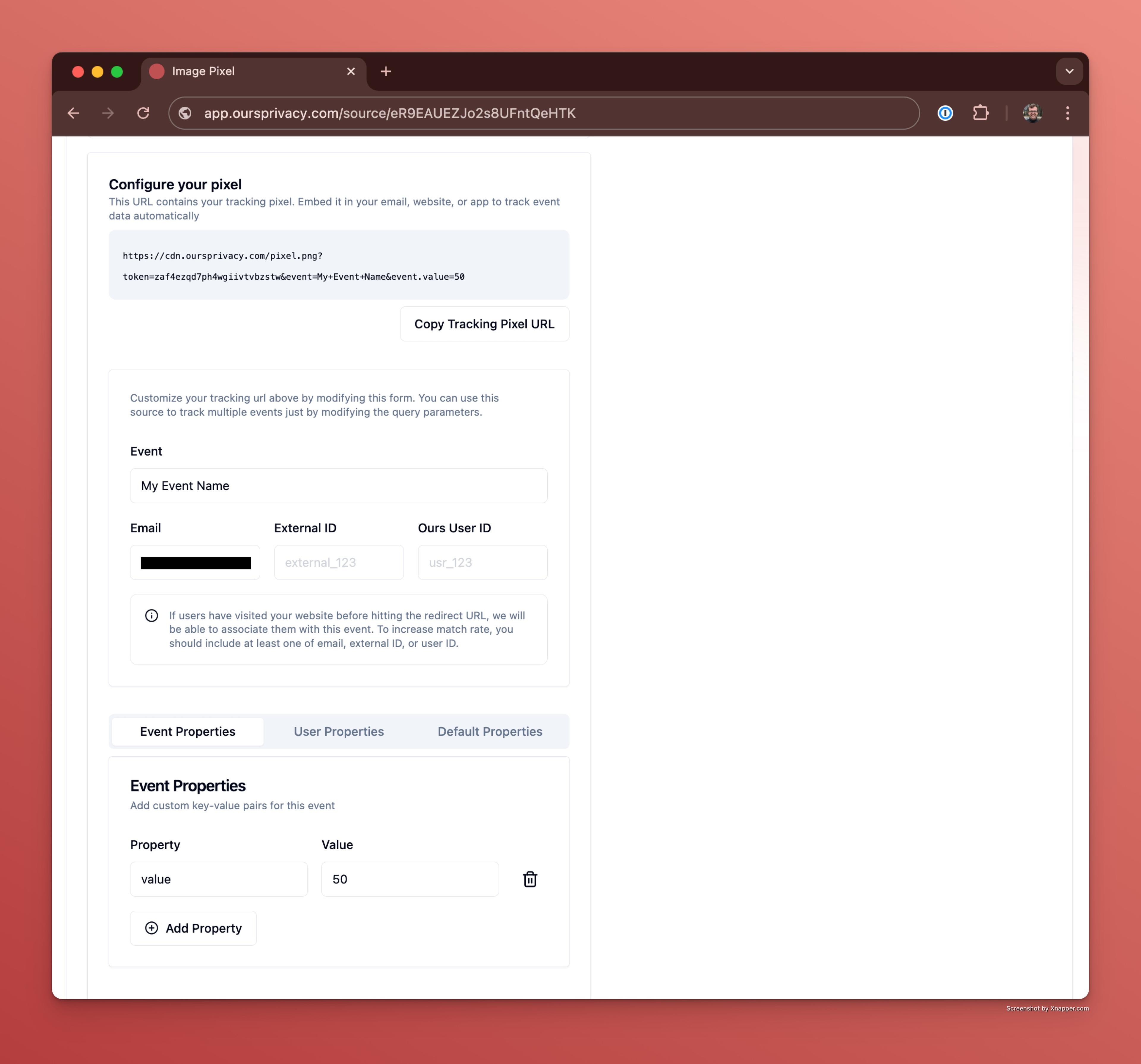
To add this source to your account, go to Sources > Add Source. Then, select the Pixel source. You can use the form builder to configure your tracking pixel before using it.
How It Works
The impression pixel works through a simple but powerful mechanism:
-
Pixel Loading: When the 1x1 invisible pixel image is loaded (either from a web page, email, or alongside an advertisement), it sends a request to the Ours Privacy API with the specified tracking data.
-
Cookie-Based Visitor Matching: Ours Privacy reads the visitor cookie for your account. If one exists, the impression is attached to that returning visitor and the cookie is refreshed. If not, the impression is still recorded, and the viewer is connected to it later through the identifiers you send or Identity Recovery.
-
Event Tracking: The impression event is automatically tracked and stored in your Ours Privacy account. Any variables passed in the pixel URL (such as click IDs, UTM parameters, or custom identifiers) are automatically collected and attached to the event.
-
Attribution: When the same person later converts on your website or other properties (tracked via the Ours Privacy Web SDK or other sources), the conversion is matched back to the original impression. The match runs on the visitor cookie first, then on any
external_idoremailyou send, which is what lets the conversion connect even when it happens on a different device. This enables view-through conversion tracking and attribution. -
Forwarding to Destinations: When conversion events are forwarded to advertising destinations like Basis or The Trade Desk, the impression data and any variables collected at the time of the impression are included, allowing the advertising platform to properly attribute the conversion to the ad impression.
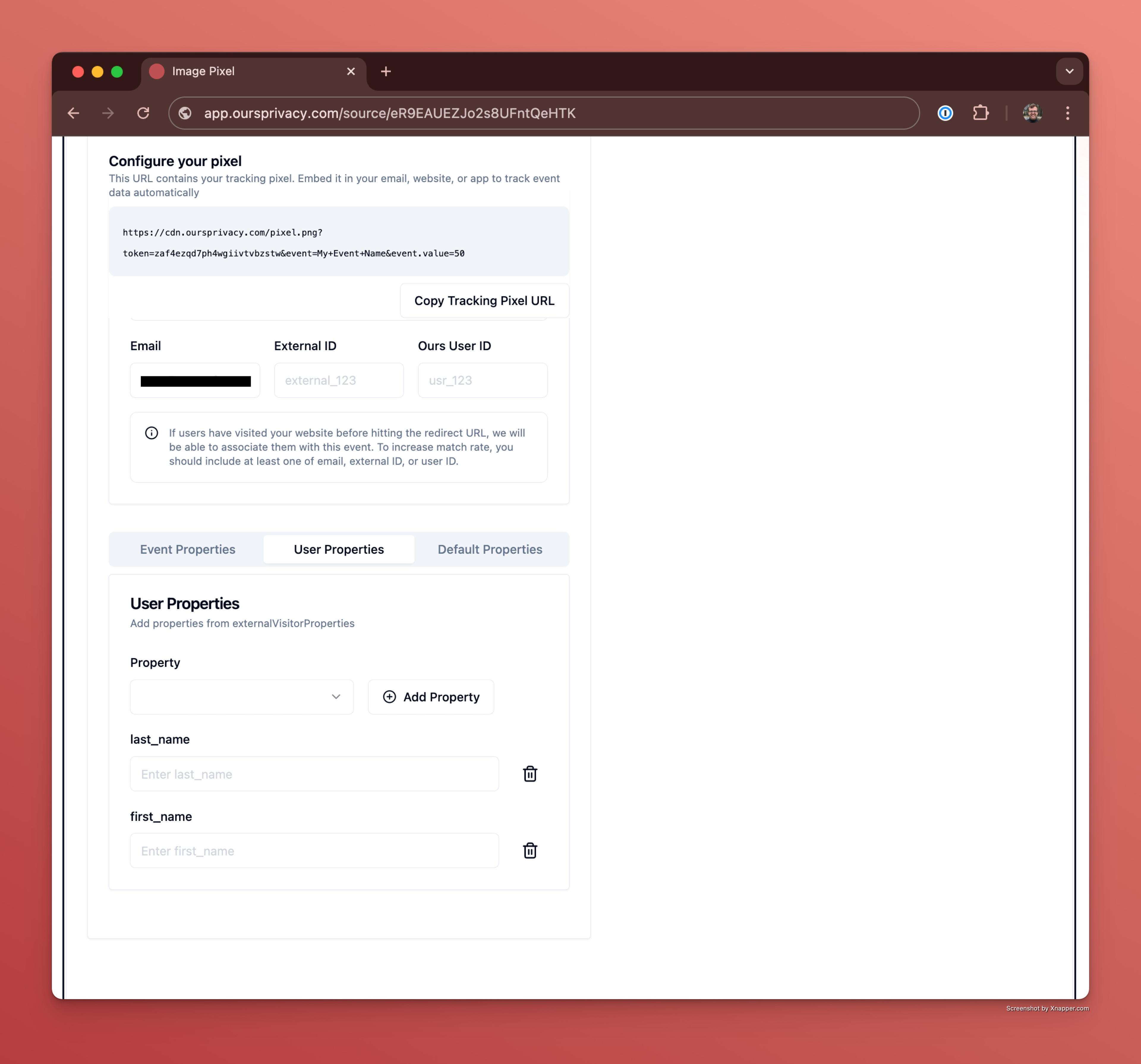
You can completely customize the event that is tracked through the pixel configuration in your Ours Privacy application. You can track custom event parameters, user properties, and set default event properties that will be automatically collected and attached to tracked events.
Passing Variables
The impression pixel allows you to pass variables through query parameters in the pixel URL. These variables are automatically collected and attached to the tracked event, making them available for attribution and forwarding to advertising destinations.
Click IDs and Advertising Identifiers
You can pass advertising platform-specific identifiers such as click IDs or auction IDs. For example, when using Basis, you can pass the Basis click ID:
default.basis_cid=abc-123These identifiers are automatically collected and forwarded to the respective advertising destination when conversion events are matched to impressions.
UTM Parameters
UTM parameters and other marketing campaign identifiers can be passed using the default. prefix:
default.utm_campaign=summer_sale
default.utm_medium=display
default.utm_source=ad_network
All UTM parameters and other variables passed via the default. prefix are automatically collected and attached to events, allowing you to track campaign performance and attribution.
Custom Parameters
You can pass any custom parameters you need for your tracking and attribution needs. Simply prefix them with default. to have them automatically collected:
default.custom_identifier=value123
default.campaign_id=456
These custom parameters will be included in the tracked event and can be forwarded to your configured destinations.
Automatic Collection
Ours Privacy automatically collects all variables passed in the impression pixel URL and attaches them to the tracked event. When a conversion event is later matched to an impression (based on cookie matching), these variables are included in the conversion event data that gets forwarded to your advertising destinations, enabling proper attribution.
Response
The API returns a 1x1 transparent GIF image. This image is used to track the event without displaying any visible content to the user.
- Content-Type:
image/png - Cache-Control:
no-store, no-cache, must-revalidate, proxy-revalidate
Integration with Advertising Destinations
The impression pixel works with advertising destinations for view-through conversion tracking and attribution. When you configure the impression pixel with advertising destinations, conversion events can be matched back to ad impressions, enabling accurate attribution reporting.
Supported Destinations
View-through measurement is documented end to end for The Trade Desk, Basis, Viant, and StackAdapt. See DSP view-through conversions for the methodology, the attribution signal each one uses, and what to confirm with your account team before relying on view-through at any other DSP.
When a destination relies on a click or auction ID, such as Basis (default.basis_cid), pass it in the pixel URL. Ours Privacy automatically collects these identifiers and forwards them to the destination when conversion events are matched to impressions. Other destinations, like The Trade Desk, match view-through conversions on their own side using device and identity signals, so no click ID is required in the pixel URL.
Example
Basic Usage
To track an event, embed the following image tag in your HTML:
<img
  src="https://cdn.oursprivacy.com/pixel.png?token={{token}}&event=My+Event+Name&event.value=50"
  width="1"
  height="1"
  alt="tracking pixel"
  style="display:none;"
/>
Impression Pixel with Variables
For advertising attribution, you can pass click IDs, UTM parameters, and other variables:
<img
  src="https://cdn.oursprivacy.com/pixel.png?token={{token}}&event=Ad+Impression&default.utm_campaign=summer_sale&default.utm_medium=display&default.utm_source=ad_network&default.basis_cid=abc-123"
  width="1"
  height="1"
  alt="impression pixel"
  style="display:none;"
/>
Using Custom Domains
If you have a custom domain configured, use your custom domain instead:
<img
  src="https://metrics.yourdomain.com/pixel.png?token={{token}}&event=Ad+Impression&default.utm_campaign=summer_sale&default.basis_cid=abc-123"
  width="1"
  height="1"
  alt="impression pixel"
  style="display:none;"
/>
All variables passed with the default. prefix (like default.utm_campaign, default.basis_cid) are automatically collected and attached to the event, making them available for attribution and forwarding to your advertising destinations.
How is this guide?