Campaigns and UTM Tags
Tag an Ours Privacy short link with campaign, source, medium, term, and content values, how they are captured as first-party event properties, and why they are not appended to your destination URL.
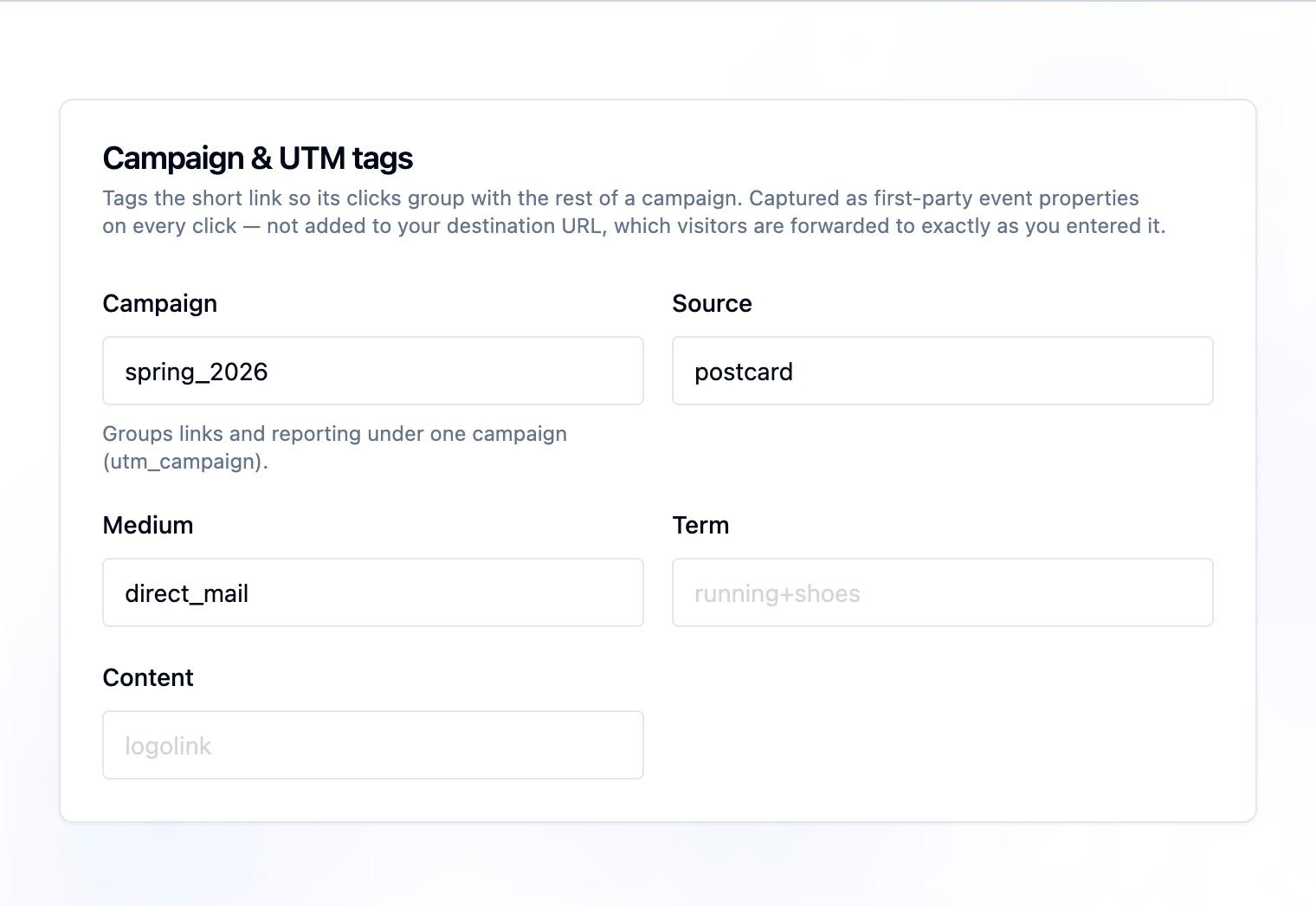
Use this page to tag a short link so its clicks group with the rest of a campaign. The Campaign & UTM tags card sits under Link details in the short link editor.
The five fields
All five are optional free text. Empty fields are left off the link entirely.
| Field | What it answers | Example |
|---|---|---|
| Campaign | Which campaign is this part of? | spring_2026 |
| Source | Where is the link placed? | postcard |
| Medium | What kind of channel is it? | direct_mail |
| Term | Which keyword or variant? | new_patient |
| Content | Which creative or position? | back_panel_qr |
Campaign is the one that does real work. It is the value short link reporting groups by, so a set of links sharing a campaign value can be measured as one campaign.
Conventions worth adopting
Campaign tags are only as useful as they are consistent, and nothing here validates your spelling.
- Pick one case and separator and hold to it.
spring_2026andSpring-2026are two different campaigns as far as reporting is concerned. - Lowercase everything. It removes a whole class of mismatch.
- Reuse the vocabulary you already use on your web and email links, so short link clicks sit alongside the rest of your campaign data instead of forming a parallel taxonomy.
- Let Medium describe the channel type, not the specific placement.
direct_mailis a medium;march_postcardis a campaign or a content value. - Copy the tags between links. The Copy design button on the QR panel brings across campaign tags as well as styling, which keeps a set of links consistent by construction.
UTM tags are not forwarded to your destination
This is the behavior most likely to surprise you, and it is deliberate.
The campaign tags are appended to the Ours Privacy short URL and captured as first-party properties on the click event. The visitor is then forwarded to your destination URL exactly as you entered it. The tags are not merged into the destination, so:
- Your landing page will not see
utm_campaignin its address bar from these fields. - Any analytics tool on the landing page that reads UTM parameters from the URL will not attribute the visit to the campaign.
- Query parameters already on your destination URL are left untouched, so nothing you put there gets rewritten or dropped.
If you also want the destination page to see the parameters, put them on the destination URL yourself:
https://northsidehealth.example/spring?utm_source=postcard&utm_medium=direct_mail&utm_campaign=spring_2026Doing both is a reasonable default: the fields in the editor make the click reportable inside Ours Privacy, and the parameters on the destination URL make the landing page visit attributable in whatever else is running on the page.
Note: Ours Privacy already ties the click and the subsequent page view to the same visitor when the visitor has an Ours Privacy cookie for your account, so duplicating the parameters is about other tools on the page rather than about your own attribution here.
Where the tags show up
Once a tagged link is published and starts getting traffic, the campaign values are available:
- On the click event as first-party properties, so you can filter and break down by them in Web Analytics.
- In audience conditions, so you can build an audience of everyone who arrived through a given campaign. See Event conditions.
- In destination mappings, so campaign values can be forwarded to a CRM or ad platform alongside the click.
Grouping links into a campaign
A campaign usually spans several placements. Create one link per placement, give each a distinct name, and give all of them the same Campaign value:
Name: Spring Postcard QR        Campaign: spring_2026   Source: postcard    Medium: direct_mail
Name: Spring Lobby Poster QR    Campaign: spring_2026   Source: lobby       Medium: signage
Name: Spring Newsletter Link    Campaign: spring_2026   Source: newsletter  Medium: email
Each link reports separately, so you can see which placement performed. The shared campaign value is what lets them be read together.
Note: The Analytics tab in the dashboard reports one link at a time. Campaign roll-up is available through the Platform API, and in Web Analytics by filtering on the campaign property.
Next Steps
- Branded domains: serve tagged links from your own domain.
- Short link click events: what else is captured alongside the tags.
- Recipes: complete campaign configurations you can copy.
How is this guide?