

Managing Short Links
Work with the Ours Privacy short links list: search, sort, duplicate, enable and disable, delete, page through large collections, and the permissions each action needs.
Use this page to work with short links after they exist: finding them, copying them, taking them out of service, and removing them.
The list lives at Marketing Center → Short Links.
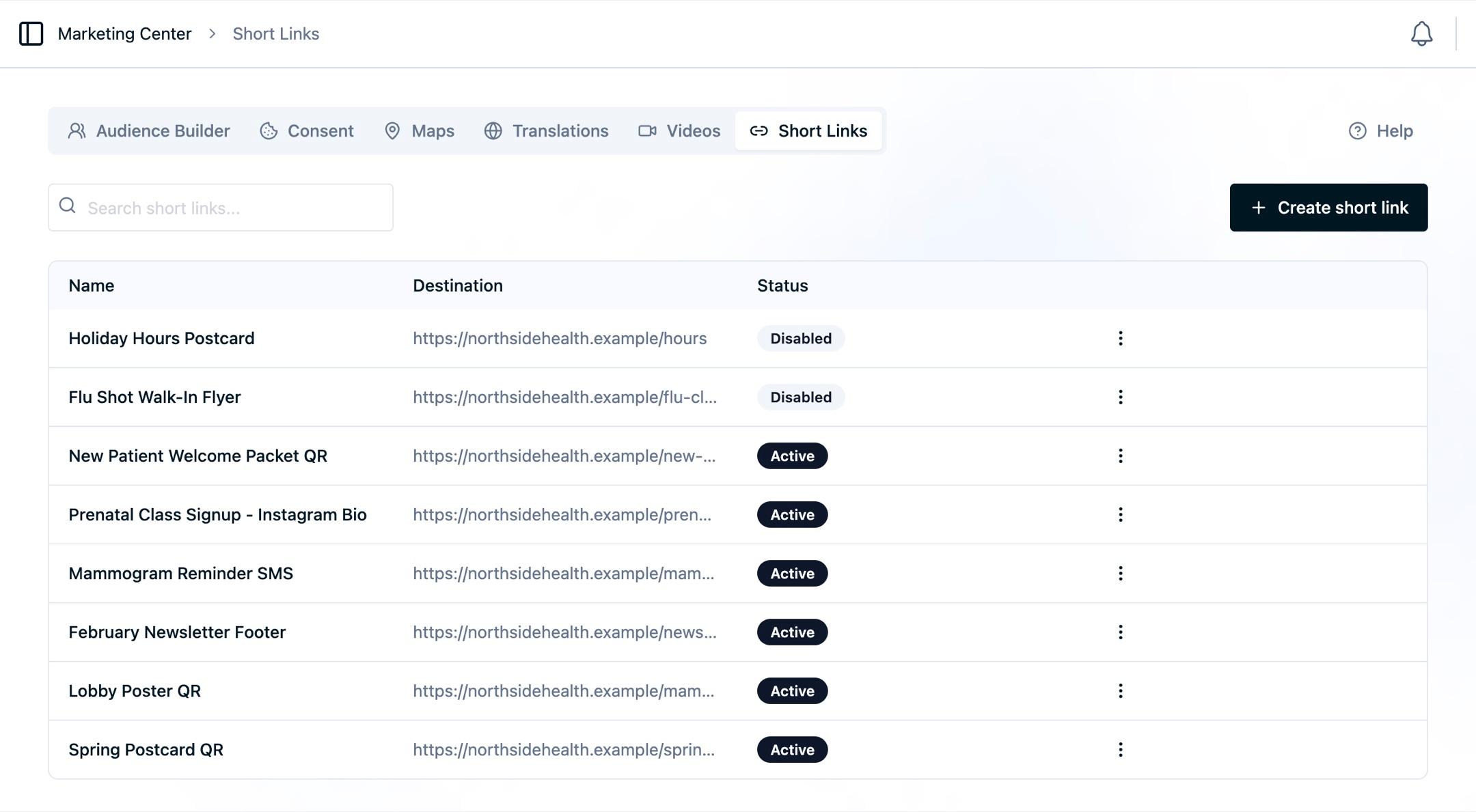
The list
Four columns, all sortable within the current page:
- Name: the link name, which is also the event name. Select it to open the editor.
- Address: the short-link path and code.
- Destination: the destination URL, truncated. Links with nothing set show No destination set.
- Status: Active or Disabled.
Search matches part of a name, destination, or short code as you type, ignoring capitalization. It searches your full collection, including links beyond the current page.
Links are listed newest first before you sort.
The list shows 25 links per page. Use Next and Previous to move through your collection. Changing the search starts again at the first matching page. The Platform API also supports pagination.
Row actions
Open the actions menu at the end of any row.
Duplicate
Creates a copy of the link, including its QR design and campaign tags, with a new short code. Use it to build a set of visually consistent campaign links: set up the first one, then duplicate and adjust the name, destination, and tags.
The copy starts disabled and unpublished. Enable it and publish before distributing it.
Enable and disable
Disabling takes a link out of service without destroying it. A disabled link stops resolving, its printed QR codes stop working, and the readiness pill in the editor reads Disabled. Re-enable it from the editor's disabled banner or the list action menu.
Disable is the right tool for:
- A seasonal campaign that will run again next year.
- A link that was published early by mistake.
- A placement you want to retire while keeping its reporting history.
Like every other change, enabling and disabling take effect on the next publish.
Delete
Deleting is permanent and cannot be undone. The link, its QR design, and its mappings are removed, and every printed or distributed code for it stops working for good.
The confirmation dialog spells this out. If there is any chance a code is still in circulation, disable instead.
Editing an existing link
Open a link from the list to edit it. Everything is editable: name, destination, campaign tags, and QR design.
Three edits deserve thought before you make them:
| Edit | Effect |
|---|---|
| Change the destination | Every existing link and printed QR code repoints. This is the intended way to reuse printed material. |
| Rename the link | The event name changes going forward. Events already recorded keep the old name, so reporting splits across two names. |
| Disable the link | Existing codes stop resolving until you re-enable and publish. |
The header shows Unsaved changes whenever the form has drifted from what is stored. Save, then publish.
Permissions
Short links reuse the source permissions, plus one dedicated reporting permission.
| Action | Permission |
|---|---|
| View the Short Links list | Source: List |
| Open a single short link | Source: View |
| Create a short link | Source: Create |
| Edit a link, its design, or its status | Source: Update |
| Delete a link | Source: Delete |
| See the branded domain picker | Custom domain access |
| Open the Analytics tab and read reporting | View Short Link Reporting |
View Short Link Reporting is granted separately from the rest because click analytics can carry protected health information. Without it, the Design and Analytics tabs do not appear at all and the analytics route reports no access.
Without Source: List, the page explains that you need the source list permission rather than showing an empty list. Ask your account administrator for the permission you are missing.
Next Steps
- Short link reporting: read the Analytics tab.
- Automating short links: manage links in bulk through the API.
- Short link FAQs: answers to the questions this page raises.
How is this guide?